
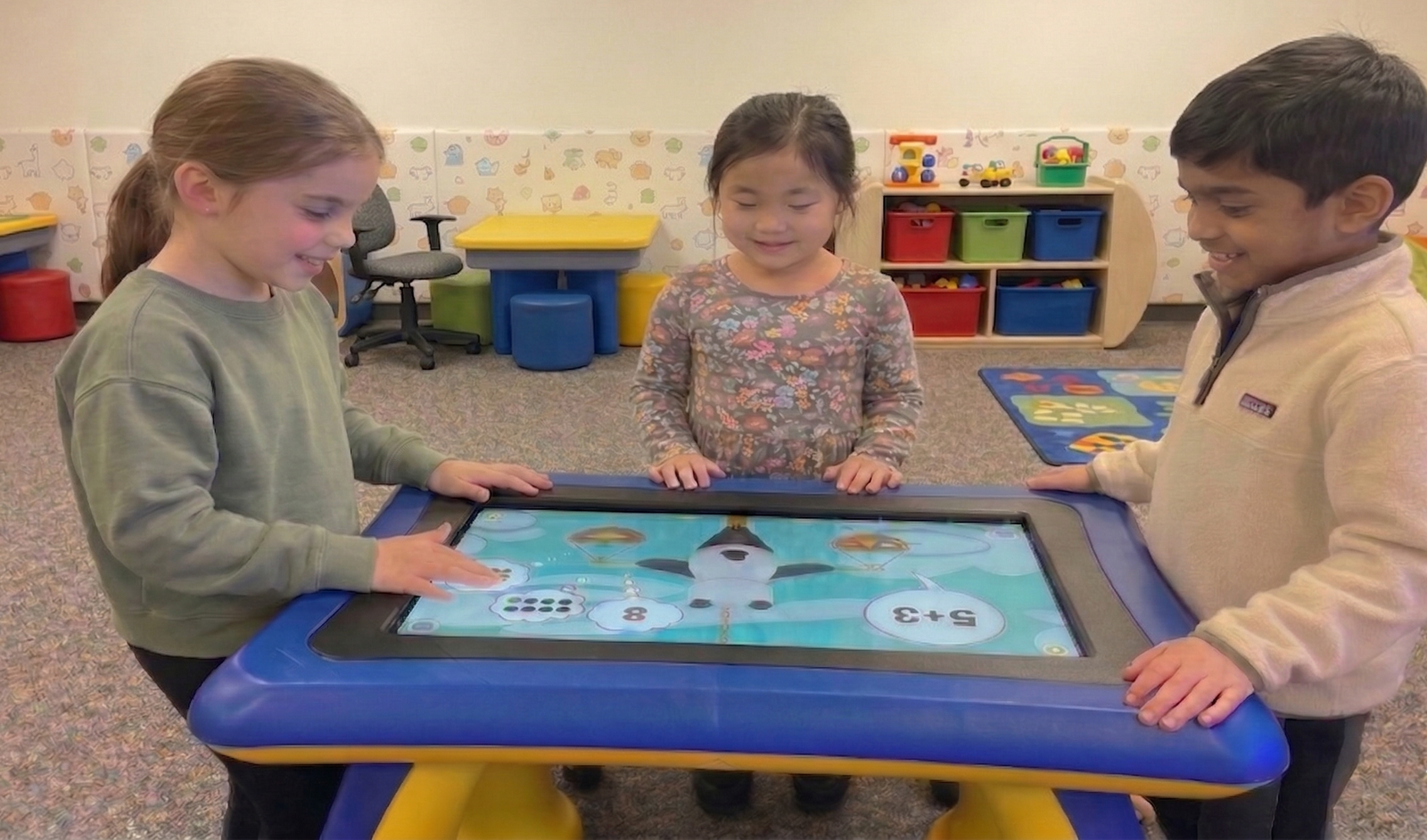
In our last post, we talked about the importance of building mathematical fluency and conceptual understanding. Let’s look at how these abstract concepts come to life on the Playmove Table. If you’re looking for a way to turn developing number sense into an edge-of-your-seat challenge, let us introduce you to our wobbly panda friend.
The Mission: Keep the Panda Balanced
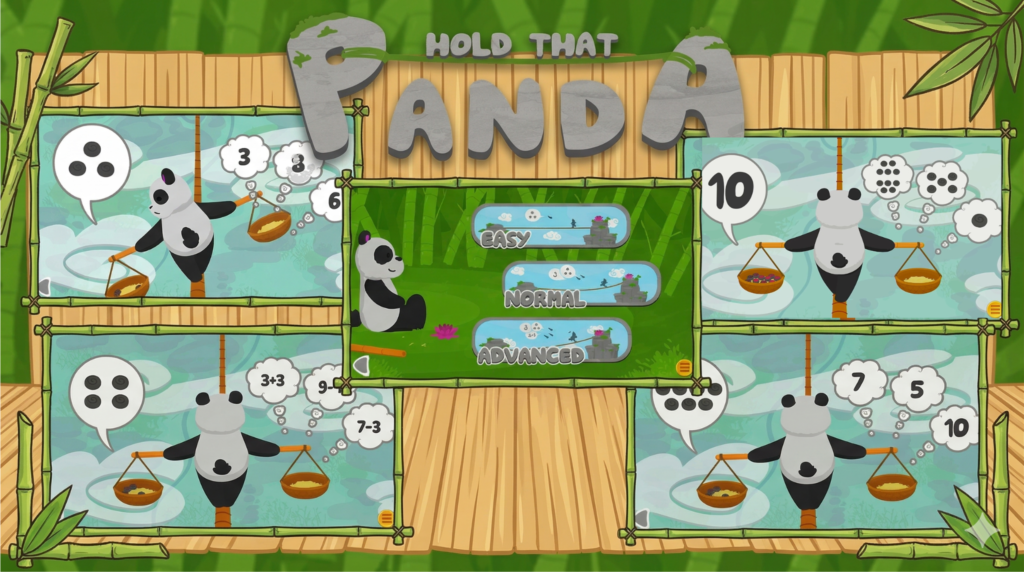
In Hold That Panda, designed ages 3 and up, children meet a panda who loves walking the tightrope. However, he loses his balance easily if the weight isn’t distributed perfectly. To keep him steady, players must ensure that both baskets he carries contain an equivalent quantity of objects. It is a visual, tactile way to teach children equivalency and help them develop their initial understanding of number sense in a fun and engaging way.
A Natural Progression of Skills
The game is designed to grow alongside the learner. In the Easy and Normal modes, the focus is on developing the foundational ability to relate physical quantities (like dots or objects) to their numerical representations. As children move through these stages, the challenges increase in difficulty, helping them build confidence in recognizing numbers at a glance.
Once they’ve mastered the basics, the Advanced level introduces basic mathematical operations. Here, students are tasked with solving addition and subtraction problems to determine exactly how many items are needed to keep the baskets even. For these early learners, the focus remains on foundational fluency, with problems involving numbers up to 10.
Why Educators Love It
We’ve integrated several key developmental opportunities into the tightrope challenge to ensure it supports the whole child:
- Subitizing & Visual Perception: By using dot patterns, the game strengthens a child’s ability to “see” a number without counting every dot individually, which is a critical step toward mental math fluency.
- Persistence & Resilience: Because the Panda reacts in real-time to their choices, students receive immediate feedback. If he tips, they need a new strategy to find the balance.
- Communication & Reflection: The game serves as a brilliant prompt for students to verbalize their strategies, helping them justify their mathematical choices to family, peers, or teachers.
Bringing the Lesson into the Classroom
Technology works best when it acts as a bridge to further conversation. Teachers and families can use Hold That Panda as a starting point to explore concepts of equality and difference in the real world. You might encourage children to verbalize their choices by asking, “How did you know that would make the baskets balance?” or “What happens to the Panda if we add one more?”.
By combining this purposeful digital play with follow-up activities using concrete objects, we help children move from memorizing math facts to truly understanding the logic of the world around them.